Monday, January 18, 2010

The Lotus Guest House at Dabzang Monastery in Boudhanath, NEPAL and Menri Monastery in North India THE BONPO... building a library in Humla


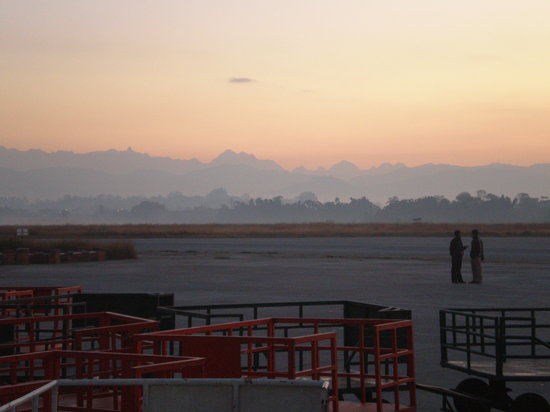
Kathmandu, Nepal: Himalaya near Pokhara

Himalaya near Pokhara

A Day In Kathmandu
  Having an attraction to  the Tibetan culture I decided 
Nepal would be a place to visit.  Since the Chinese invasion of Tibet in the 1950's Tibetan culture has been diluted with Chinese influence and many Tibetans have fled to Nepal. I don't want to witness Tibet today.  I have to accept the fact that the old Tibet is gone and I missed the opportunity of seeing it in its true form by not going thirty years ago.  
My great friend,  Tempa Lama, asked me to build a school in his home village in 
Humla, Nepal.   I  located a U.S. foundation that builds libraries in Nepal, so I made a goal of building a library in a village close to Tempa's village in Simikot.  For me, travel without a purpose is as dull as dust.  I don't shop and in developing countries it is difficult to find a clean restaurant, by western standards, to use eating as a pass time.  I like to spend my time living in or around Tibetan Monasteries and teaching English slang is a favorite course I teach.  Last spring I taught "Dude" slang expressions to monks in Sikkim, ranging in age from 7-29.  The classroom was small and so full the monks were squeezed together on the floor.  
     I checked online for weeks in search of the best priced round-trip ticket to 
Kathmandu.  I found shopping online for the best deals a way to see the practices and  patterns of Orbitz and other online ticket distributors.  In the end I was assigned seating and dates and flights I had not agreed to with my airline purchase but there was nothing I could do to change the new circumstances.  Saving money on flights almost never pays off.  I took a trip from Bangkok, Thailand to Kathmandu, Nepalvia Bangladesh and was told by a passenger that I indeed  had a cockroach crawling up my leg.  I had a bad room experience and there was nothing I could do about it in Bangladesh because I am woman with blonde hair traveling alone.  The hotel clerk walked into my room all night long asking for a tip or using any excuse he could to enter.  
     I stayed in Boudhanath, the Tibetan area of 
Kathmandu, at a monastery.  The day I arrived an eleven day puja  (a spiritual cleansing) had begun.  At 4 a.m. the 16' horns, 6' drums and 150 chanting Tibetan monks began their prayers and continuing until 10p.m. I loved it.  A moment I hold dear.   From time to time I would go into the Temple where I would be treated in a lovely manner by the little monks who would hand me a bag of candy and fruit.  I originally thought I would put to use the 25 years of meditation practice but the little monks were far to active for me to not want to keep my eyes on them.  The nature of a Tibetan Buddhist Temple is colorful and busy and so are the young monks.  
     I formed a committee of Tibetans who were from Humla but lived in the city now for the library we wanted to get built.   READNepal offices are in 
Kathmandu so we met there on several occasions learning more on the criteria, guidelines and requirements set by READNepal.  After more than two months I decided it was time to leave Nepal as it was quite obvious the process for getting a library built takes time.  I went into town to look for the airline office to pick up my ticket back to Bangkok.  The taxi driver could only get me near the area the office was in.  He couldn't find it.  I got out to walk the rest of the way...to see if I could find my way.  I asked for help on several occasions and within the hour I thought I had received some good directions from kind people in a shop.  I walked out of their door and turned left, I walked two blocks and crossed at the light to the right and walked one more block and then I was turning the corner watching the ground for any animal poop when I saw a pair of brand new black shoes.  Not many people in Kathmandu have brand new black shoes.  As my eyes pulled up from the shoes to the sharp black pants I drew my eyes up further to see a black belt and then a black shirt...bright black shirt then up some more I notice the persons hands are covered with black gloves.  It was a warm day I thought as I saw the neck of this person was also covered in a black fabric when I looked up to see a face I was stunned to see that the face was covered in a Ninja mask.  As I tried to look into the mask a fist came shooting out of nowhere, well from his body and struck me in the temple.  I went falling against a brick wall and the man who punched me kept walking, as though nothing had happened.  He walked away not looking back, which goes against human instinct.  There was no skin to be seen on this person...he was completely covered.  His punch was powerful.  A man stopped briefly to ask me if I knew the man who hit me.  I answered "no" and he said "Oh" and walked on.  I stopped at The Travel Police to report the incident and the cop laughed.  I had a bruise on my face and he thought this was quite funny.
     The first day I was in 
Kathmandu I saw 4 Maoist's beating and kicking a twelve year old Tibetan Monk and then I watched them pull him upstairs, face first.  He was screaming as his face bounced off the marble stairs.  One of the Maoist's was a woman who kicked this little boy in the kidneys.  I wondered how the loving mother had been removed from her.  Maoist's scare me.  

Menri Monastery in North India 

Letter from
 the Dalai Lama
Origin of 
Bon
Origin of
 Bon
Photo Gallery
About BonThe Yungdrung Bon Monastic Center
The Menri MonasteryThe 
Redna Menling Nunnery
The Bon Children's Home

About Bon and Menri

Abbot with Text
Among the many Tibetans who fled their homeland since the Chinese occupation of Tibet in 1959, many are Bonpo, followers of Bon, which is the oldest spiritual tradition of Tibet. Bonpo believe their culture to have originated in the land of Olmo Lungring (located in a larger country referred to as Tazig, a region probably to the west of present-day Tibet) and that it flourished as it moved eastward through the Kingdom of Zhang Zhung, which made up much of what is now western Tibet. The ancient roots of Bon religion derive from a profound respect for nature and emphasize the healing of physical and environmental as well as spiritual afflictions. As Indian Buddhism was being established in Tibet, many native Bon elements were incorporated into the incoming religion, resulting in a distinct religion known today as Tibetan Buddhism. In turn, Buddhist influences are abundantly evident in Bon religion as it currently exists. The two religions are distinct in many ways but share a strong and identical commitment to bringing an end to all suffering. Although they trace their origins to ancient times, Bonpo practice a living doctrine dedicated to perpetuating the teachings of their founder Tonpa Shenrab, who occupies a preeminent position in Bon culture similar to that of Sakyamuni in Buddhism. Tonpa Shenrab's teachings are collectively known as Yungdrung Bon or the "tradition of Eternal Wisdom" and include the Nine Ways of Bon that outline the laws of cause and effect on the path to spiritual liberation. Bon monasteries have survived throughout Tibet despite long periods of persecution. H. H. the Dalai Lama's recognition of Bon as the native religion of Tibet and one of its five core spiritual traditions is an important acknowledgement of Bon's significant role in Tibetan history and current affairs.

The Menri Monastery View 
of Menri Monastery main temple Notes from the journal of
John Bellezza, scholar-explorer, 2006


Menri (Medicine Mountain) Monastery is located in the Solan district of Himachal Pradesh, in a rather out of the way corner, far from cities and bazaars. How this place has changed in recent years! From a sleepy, albeit culturally important backwater, Menri has become a bustling hub of religious learning and ritual activity. Until 1998, Menri was a very rudimentary facility with a few simple adobe and stone buildings. Even the main temple was bereft of the rich decorations that have come to characterize Tibetan religious edifices. There were around 100 monks then. Now there are over 350 residents, and large concrete Tibetan-style buildings have come up to house the new temples, a library, Bon Dialectic School, dormitories, health center, and nunnery as well as other well functioning centers.

The chief lama of Menri Monastery is Menri Trizin, who is also the titular head of all the Bonpo. Now aged 80, His Holiness still maintains a full work schedule, overseeing important functions at the monastery. A typical day will see Menri Trizin delegating tasks to his circle of leading monks (all of whom hold the Doctor of Divinity or Geshe degree), participating in religious ceremonies, receiving visitors, dictating letters, and supervising construction and education projects. Menri Trizin fulfills his role as spiritual leader of the Bonpo admirably well, and he cuts an impressive figure with his deep resonant voice and regal bearing. His Holiness however, is a good listener and is always ready to help all who seek him out. In short, he is the ideal spiritual beacon.

HH blessing
It is good to see the Bonpo finally come out from under the shadow of the Tibetan Buddhists, and to take their rightful place in the international spiritual community. It is no exaggeration to state that Bon has everything Tibetan Buddhism has, and much more too. There are still many who believe that Tibet is synonymous with Buddhism, not realizing that it is home to another of the world's great religions. Fortunately, attitudes are changing as the Bonpo reach out to the rest of the world with ever greater vibrancy. In addition to possessing the doctrinal traditions and ecclesiastic structures of Tibetan Buddhism, Bon has preserved a variety of more ancient cultural traditions. This is of course my area of scholarship.

Needless to say, native Bon traditions are of great interest to historians, anthropologists, and archeologists. But they are also highly valuable in a practical sense, for they contain much that is of relevance to human physical and mental well being. To name but a few aspects of Bon's indigenous heritage, there are medical therapies, rituals for psychological contentment, systems of divination, and special rites for environmental harmony. This profound pre-Buddhist spiritual bequest draws its inspiration from the primal well-spring of human experience, seen as the universal birthright of us all. The Bonpo believe that the foundation of our human identity has been ignored in the theologies and institutional frameworks of the other major world religions. Often mistakenly equated with shamanism by laypeople and poorly-informed religious scholars, the ancient Bon legacy is actually concerned with divinity as it abides in all natural systems. It is held that this divinity or essential state is tantamount to human beings in their fundamental phenomenological form. Known as the "natural state of mind", this view of reality is elucidated in a highly advanced system of teachings known as Dzogchen. Wed to Buddhist cosmological and ethical traditions over the last twelve centuries, Dzogchen is considered the highest of Bon teachings. Back to top

The Yungdrung Bon Monastic Center
Preserving Sacred Traditions
Under the leadership of the Abbot H. H. Menri Trizin, a group of Geshes representing each sector of the monastic and educational community is responsible for the planning, administration, development, and finances at Menri. The democratically- structured YBMC functions, in effect, as the operational office of the Menri complex.

The Redna Menling Nunnery
Nun's temple
A new Bon nunnery is being completed in a pristine setting across the river from, and in view of, Menri Monastery. Called Redna Menling or "Land of Precious Medicine," it is the only Bon nunnery in India and only one of a handful in the world. Girls and women from Tibet and the borderlands arrive here to study and remain as nuns in the Bon culture. Redna Menling is a rapidly growing institution that is a solid reflection of women as leaders and practitioners of the Bon tradition.

The Menri Bon Children
Menri is a refuge for approximately 350 Bon children whose numbers increase each year. The children -- some of whom are orphaned -- are sent to Menri from poor regions in the borderlands of Tibet and Nepal for their sustenance and education. Boys whose families send them to the monastery are trained as monks. Girls who are placed in the nunnery are trained as nuns. Also within the Menri complex is the Bon Children's Home with dormitories for boys and girls who were sent to Menri for basic care and education.
Girls 
and boys at the Bon Children's Home All children, including the young monks and nuns, attend school together at the Central School for Tibetans. Situated in the valley below the monastery, the school is run by the Indian government and provides education through the tenth grade. Because Bon tradition places such high value on education and on the continuation of the Bon culture and tradition, the school includes a strong component of Bon studies. Education is regarded as an absolute necessity for the future of Bon.

Back to top

Menri
 Child
Bon Monk
Bon Nun
Higher Ed
Genreal Fund
Abbot's Wish

tell a 
friend Join the 
Bon Foundation E-mail list
About Us Reading 
List Events 
Calendar Contact 
Us Related 
Links
© Copyright The Bon Foundation 2009 All rights reserved   l   Privacy Policy   l   Design: Tong/Ngai
Photos: Chelsea Abrose, Bill Megalos, Jonathan Kramer, Mary Ellen McCourt, and other Menri visitors.

1 comment:

Ima Wizer said...

Another great piece...scary though....
Did you ever know my friend Rick Kokenes who cleaned up the Dalai Lama's town in 1998? He was murdered in the southernmost town of India that year while on R&R after the cleanup. He was my dearest friend. And came there from Santa Fe...he traveled the world for many years.

About Me

My photo
San Francisco, Santa Fe and San Cristobal de las Casas, Chiapas
I am a single woman who travels the planet alone....a 25 year practicing Buddhist, Fine Art Consultant, Mother, Travel writer, Vegetarian cook who writes recipes, makes shrines and goes to far away places alone

Blog Archive